Vipin Kumar
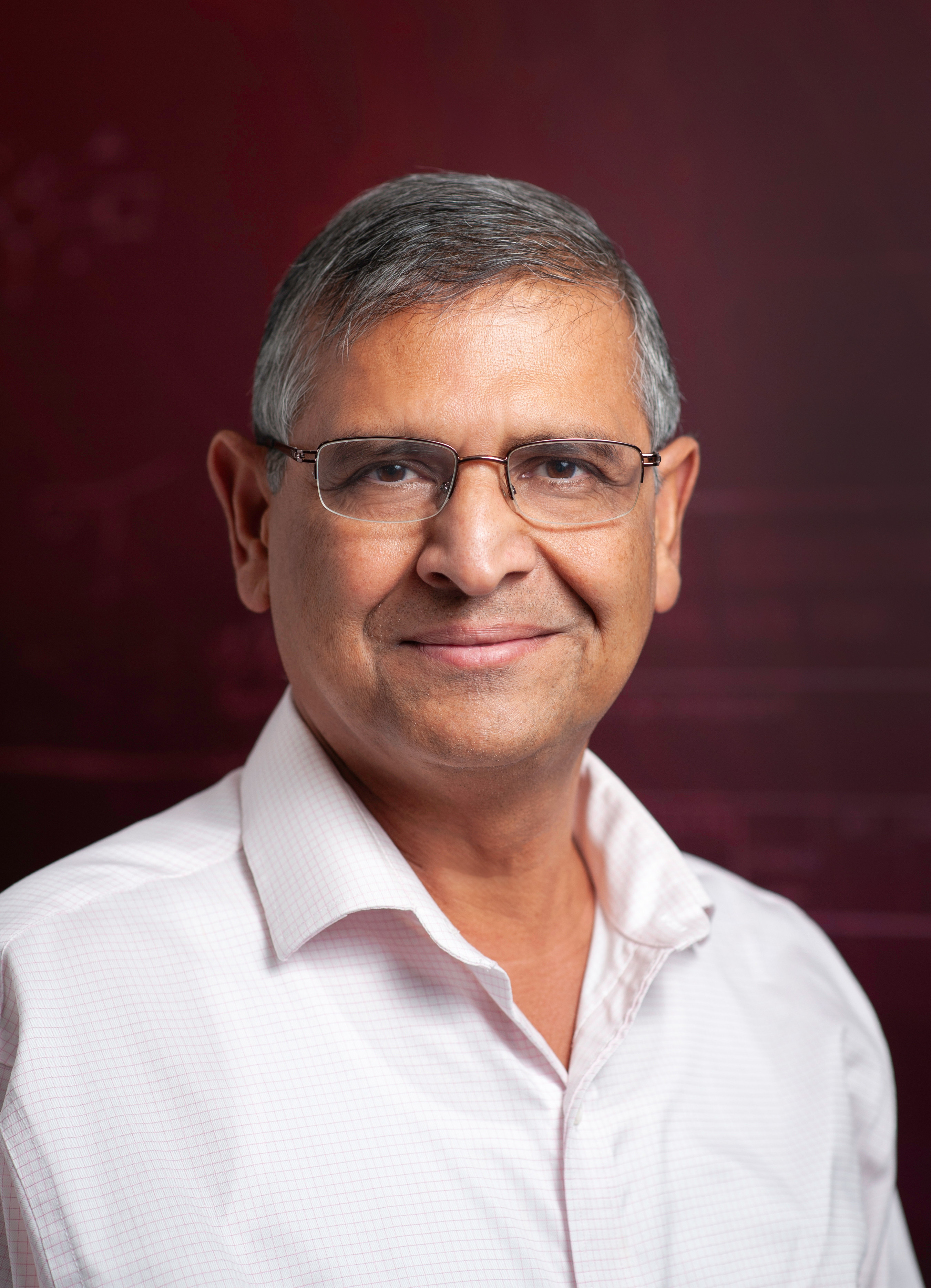
Regents Professor
William Norris Land Grant Chair in Large-Scale Computing
Department of Computer Science & Engineering
Director, CSE Data Science Initiative
Keller Hall 4-250B
University of Minnesota
612 624 8023
[email protected]
Assistant
Bobbie (Barbara) Scott
[email protected]
Phone: 612-626-7014
Links
Download Kumar CV
(Updated March 20, 2026)
Biography
Vipin Kumar is a Regents Professor and William Norris Land Grant Chair in the Department of Computer Science and Engineering at the University of Minnesota. He was appointed in 2026 to the inaugural United Nations Independent International Scientific Panel on Artificial Intelligence. He is internationally recognized for foundational contributions to artificial intelligence, high-performance computing, and data science, as well as leadership in AI-driven scientific discovery.
Kumar’s early research on accelerating AI problem-solving search algorithms led to the development of the isoefficiency analysis framework, the first rigorous method for analyzing scalability of parallel algorithms. This work influenced the design of practical parallel methods and large-scale computing systems across diverse domains, including molecular and fluid dynamics, structural mechanics, genetic programming, and training of large-scale neural networks. This line of work also led to multilevel graph partitioning algorithms and software, including METIS, ParMETIS, and hMETIS, that underpin large-scale multiphysics simulations and engineering platforms worldwide, as well as applications ranging from circuit design to social network analysis. Building on this foundation, his group developed clustering, association analysis, and anomaly detection methods that are widely cited in data mining and underpin large-scale analytics software. From 1998 to 2005, he served as Director of the Army High-Performance Computing Research Center, then the Department of Defense’s largest extramural high-performance computing program, where he led interdisciplinary research on scalable algorithms, high-performance computing systems, and their application to challenging scientific and engineering problems.
Kumar was among the first computer scientists to bring data science and machine learning to address global environmental challenges. Beginning in the early 2000s, his team pioneered the use of data-driven approaches at planetary scale to detect large-scale environmental change and uncover previously unknown Earth system relationships. As Principal Investigator of the NSF Expeditions in Computing project, Understanding Climate Change: A Data-Driven Approach, he led a multidisciplinary effort that demonstrated how machine learning can complement traditional Earth system modeling. His team produced widely used global datasets, including the first automated global history of ecosystem disturbances, discovered new climate teleconnections, and transformed planetary-scale monitoring of forests, water bodies, and other ecosystem changes.
Building on this work, Kumar introduced Knowledge-Guided Machine Learning (KGML), a paradigm that integrates scientific principles and physical laws directly into machine learning architectures and training procedures. Developed in response to the limitations of both purely data-driven and physics-only models in complex scientific systems, KGML improves generalization, robustness, and scientific consistency beyond what either approach can achieve alone. His group has demonstrated KGML’s effectiveness in hydrology, aquatic science, and agriculture, including freshwater quality forecasting and monitoring agricultural greenhouse-gas emissions.
Beyond his research contributions, Kumar has played a leadership role in advancing AI for Science at the national level. He has led NSF-sponsored workshops on AI-enabled scientific revolutions and organized KGML and GenAI4Science workshops that bring together academia, industry, and federal agencies to define research priorities at the intersection of AI and science.
Kumar has co-authored over 400 research articles and 11 books, including two widely used textbooks, Introduction to Parallel Computing and Introduction to Data Mining, and edited volumes, Knowledge Guided Machine Learning (2022) and Search in Artificial Intelligence (1988). His foundational research in artificial intelligence, high-performance computing, data mining, and their applications to a wide range of scientific problems has been honored with awards including the ACM SIGKDD Innovation Award (2012), the IEEE Computer Society Sidney Fernbach Award (2016), the SC21 Test-of-Time Award (2021), and the IEEE Computer Society Edward J. McCluskey Technical Achievement Award (2005). Kumar is a Fellow of AAAI, AAAS, ACM, IEEE, and SIAM.